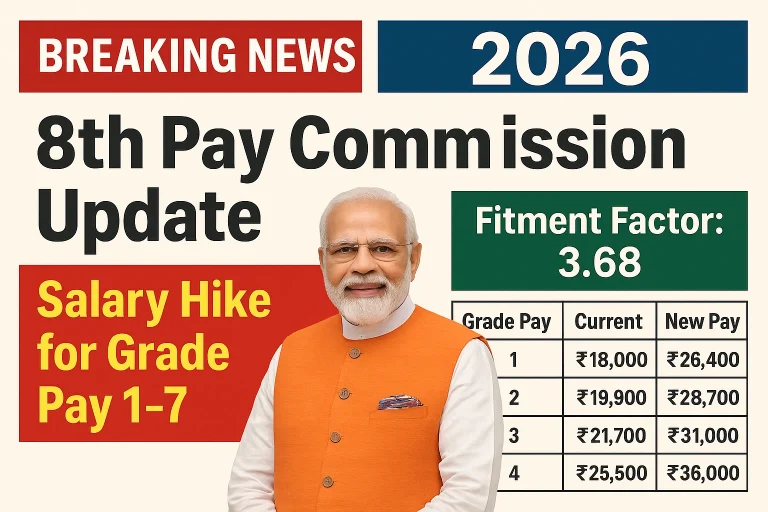
The long wait for the 8th Central Pay Commission (8th CPC) has turned into the biggest topic of discussion among Central Government employees across India. With thousands of employees hoping for a meaningful salary increase, the buzz around the next pay commission has grown stronger as 2026 approaches—the expected year of implementation. Although the government has not officially announced the formation of the 8th CPC, new reports, expert opinions, and internal discussions suggest that a significant pay hike may be on the way. According to early estimates, salaries could increase by ₹85,000 to ₹95,000 per month for certain categories if the new pay structure follows expected recommendations.
This article breaks down every major detail—expected fitment factor, predicted minimum salary rise, pension impact, DA merger, benefits for employees, timeline, and what workers can realistically expect when the 8th Pay Commission becomes a reality. The goal is to present everything in a natural, human-like style so readers can easily understand the real situation without technical confusion.
What the 8th CPC Means for Central Government Employees
The 8th Central Pay Commission is expected to be the next major salary revision mechanism for Central Government employees, defence personnel, and pensioners. Every pay commission historically introduces a completely fresh pay structure, new grade pay rules, updated allowances, and revised pension formulas. Because the 7th CPC was implemented in 2016, the next revision is naturally expected in 2026, as India has been following a 10-year cycle since the 4th CPC.
Big News for Pensioners! DA Hike 2025 to Deliver Huge Income Rise Starting January
For employees, the biggest expectation revolves around whether the 8th CPC will bring a meaningful salary hike to address inflation, rising living costs, and stagnant pay growth. Many worker unions argue that salaries have not kept pace with real-life expenses during the 7th CPC period, and therefore, a strong uplift is necessary. The anticipation has turned into hope, especially after economic analysts suggested that the next pay commission may introduce a much higher fitment factor than before.
Expected Fitment Factor: The Key to the ₹95,000 Salary Hike
The fitment factor is the most important element of any pay commission, as it directly determines the size of salary increases. Under the 7th CPC, the fitment factor was 2.57, which increased the minimum basic pay from ₹7,000 to ₹18,000. Since then, labour costs, inflation, and DA accumulation have grown significantly. Trade unions and employee groups are demanding a much higher multiplier this time.
Experts predict a new fitment factor between 3.5 and 4.2, depending on government calculations and economic conditions. A fitment factor at this level could substantially boost salaries across all categories. For example:
- A current basic pay of ₹18,000 could jump to around ₹63,000–₹75,000
- Mid-level employees could see increases of ₹55,000–₹80,000
- Higher-grade officers could receive monthly boosts of ₹85,000 to ₹95,000
These numbers are not final, but they are realistic estimates based on previous pay commission patterns and wage growth expectations.
How the New Minimum Salary Could Look from 2026
One of the most closely watched figures is the new minimum basic salary. Worker unions are pushing hard for a minimum pay between ₹26,000 and ₹30,000, citing rising prices and higher DA requirements. If the government merges DA into the new pay structure—as it always does—employees could begin their new pay cycle at a significantly higher base level.
The final minimum pay will depend on the approved fitment factor, inflation, and GDP growth. However, early calculations indicate that the new minimum pay will be at least 40% higher than the current structure. This will automatically lift all pay matrix levels, ensuring mid-level and senior employees also experience robust increments under the 8th CPC.
Will DA Merger Happen Before the 8th CPC?
The merger of Dearness Allowance (DA) is another major topic connected to the next pay commission. When DA crosses 50%, government rules traditionally call for a review, and as DA continues to climb every six months, merger seems almost inevitable.
Merging DA into basic pay before the 8th CPC implementation would allow the government to reset the salary structure more smoothly. It would also increase employee take-home income and pension calculations. Currently, DA is heading toward higher levels, making a merger highly likely before 2026.
Pensioners Stand to Benefit Significantly from 8th CPC
Pensioners are equally invested in the 8th CPC developments because pension amounts are directly tied to basic pay. A higher fitment factor will naturally increase both pension and family pension figures. Additionally, if the new pay commission introduces revised pension formulas—as some experts believe—it could help older pensioners receive fairer compensation.
Just like employees, pensioners may gain an additional ₹40,000 to ₹60,000 per month depending on their previous pay scale. Lower-level pensioners will also benefit from DA merger and new minimum pension calculations.
Why Employees Believe 2026 Will Be a Turning Point
Most government employees view 2026 as a crucial year because it will mark ten years since the implementation of the 7th CPC. Historically, pay commissions have followed a similar timeline. Moreover, several reports indicate that internal departments have begun early-stage discussions on the structure and requirements for the upcoming pay commission.
While there is no official announcement yet, the pattern of previous years strongly supports the possibility that the government will constitute the 8th CPC committee within the next year. If this happens, employees can expect draft recommendations by 2025 and implementation by January 2026, similar to how the 7th CPC unfolded.
Why Salaries Could Increase Up to ₹95,000: Expert Breakdown
Let’s break down why analysts suggest such a dramatic increase for upper-level employees:
- Steady inflation over the past decade
- Higher DA accumulation approaching 50%
- Growth in GDP and tax revenue
- Need to boost purchasing power in the economy
- Salary stagnation within 7th CPC pay matrix
- Rising cost of living in metro and tier-2 cities
When all these elements are combined, a strong pay increase seems economically justified. The government will also factor in political and administrative needs before finalizing numbers.
For higher officers and mid-range positions, the biggest jumps occur because their pay matrix levels already begin at high amounts. When multiplied by a new fitment factor—especially above 3.5—the increase naturally lands in the ₹70,000–₹95,000 bracket.
Changes Expected in Salary Structure and Allowances
Every new pay commission brings changes not only to basic pay but also to allowances. The 8th CPC could include modifications to:
- House Rent Allowance (HRA)
- Transport Allowance (TA)
- Medical Allowance
- Risk & Hardship Allowance
- Special Duty Allowances
- City Compensatory Allowances
If inflation continues to rise, HRA itself may increase by 10–12%. The allowance structure could become more flexible, with improved benefits for defence employees and those serving in special conditions.
Will the Government Replace Pay Commissions After 8th CPC?
There have been discussions in past years about replacing the pay commission system with automatic pay revision mechanisms. While this was considered, no official decision has been implemented. Most analysts believe that the 8th CPC will still follow the traditional structure because automatic revision formulas lack clarity. After 2026, however, India might explore hybrid methods to revise salaries more frequently without waiting ten years.
Economic Impact of the 8th CPC on the Country
A big salary revision always affects the national economy. Increased salaries lead to higher spending, which boosts businesses, industries, and services. At the same time, it increases the government’s financial burden. However, with India’s growing economic size and higher tax collection, many experts believe the government can comfortably manage the financial responsibility of the 8th CPC.
Moreover, raising salaries helps the domestic market grow, which is essential for long-term stability.
What Employees Should Expect Next
Until the government makes an official announcement, everything remains an estimate. But the signals are strong:
- Employee unions have intensified their demands
- Discussions are increasing within government circles
- Economic indicators support the need for revised pay
- The 10-year cycle aligns perfectly with 2026
If the government sets up the 8th CPC panel soon, employees will begin to see draft reports, discussions, and updates through 2025, followed by full implementation in January 2026.
Conclusion
The 8th Central Pay Commission is shaping up to be one of the most significant salary revisions in recent years. With expected increases of up to ₹95,000 for certain categories, employees have strong hopes that the new pay structure will address real-life expenses and restore purchasing power. Although the final numbers may vary, the trends clearly suggest that the salary hike under the 8th CPC will be substantial.
As 2026 draws near, employees, pensioners, and families are watching every update carefully. If the government aligns economic conditions and employee welfare, the next pay commission could bring financial relief, improved living standards, and a fresh chapter for millions of workers across India.